Last week, the 2012 Oscar Nominations were released, with Martin Scorsese's
Hugo winning 11 nominations & Michel Hazanavicius's
The Artist with a close 10. It's interesting that these two have the most nominations, because these two are similar in themes. Many reviewers have said of both films that they are love letters to cinema, but isn't every film a love letter to cinema (as one reviewer said that
Fast Five was a love letter to film). Even so, here is my short love letter to the films of 2011 that I found significant.
5.
Poetry- Directed, produced, & written by Lee Chang-dong,
Poetry follows Yang Mija (Yoon Jeong-hee), a grandmother who is searching for the beauty in life. Mija found out that she has Alzheimer's disease & her mental condition is expected to get much worse. On top of that, her grandson & his friends raped a schoolmate, which lead to her suicide. In order for the victim's family to keep quiet, the boys' parent must pay them off & money is something Mija doesn't have. Still, the poetry class she is taking causes Mija to look at the world differently & inspires her. Jeong-hee gives one of the best performances of the year in this film, which makes unexpected yet quiet turns in this sad & elegant film.
4.
The Artist- This film has been making quite a stir because it is a modern-day silent film, but it is not just a gimmick. Director & writer Michel Hazanavicious wanted to transport the audience back to the day when silent films were dying & talkies started popping up. He does it with a story about a silent film star (Jean Dujardin) who loses everything when he isn't able to transition to the new Hollywood films. The film is charming, romantic & proves the old cliché that "silent films were never silent" & silent films aren't really dead.
3.
Beginners- Inspired by his father, Mike Mills created a bittersweet film about an artist, Hal (Ewan McGregor), whose father, at the age of 85, declares that he is gay. Hal starts a relationship with a French actress (Mélanie Laurent), but their past relationships & the relationship of both their parents cause uneasiness with the new couple. The film is assembled with many interconnecting flashbacks that give greater depth to characters who are searching for what we're all looking for in life: happiness.
2.
Melancholia- In this apocalyptic film, a Justine (Kirsten Dunst) is miserable on what is supposed to be the happiest day of her life. Her wedding turns out to be a complete failure thanks to family tensions & the bride's depression. Also, a rogue planet, Melancholia, is heading directly to Earth, threatening to destroy everything. Anyone who has seen a Lars Von Tier film knows that they are emotional, uncomfortable, & unique & this may be the clearest vision I have seen from the Danish filmmaker. It is a depressing film, but that's what you get from a film that is an allegory of depression.
1.
Tree of Life-
Tree of Life may be one of the most controversial films this last year, not because of its content, but because of its form. Sean Penn, who had a supporting role in the movie even said, "The screenplay is the most magnificent one that I've ever read but I couldn't find that emotion on the screen." What he's talking about is the film's jump cuts, the arbitrary lines spoken over astronomical visions & the soft plot center, which is what I loved about the film. It follows a boy, Jack (Hunter McCracken), who has a complicated relationship with his father (Brad Pitt). We view a year in the life of Jack & his family living in Texas during the 50's, yet we are also met with a 17-minute, creation of Earth sequence & juxtaposed together, we get a spiritual journey that is reminiscent of
8½ &
2001. I viewed
Tree of Life as visual poetry that is meditative, epic, & enlightening.



 Signal to Noise tells the story of a nameless film director who is dying of cancer. Struggling with the idea that he only has a couple of months left, the director debates over writing his final script; the script & the film that he has been wanting to make for years. He storyboards the magnum opus in his head & eventually writes the film, knowing that he won't see the finished product. In the end, he states that he feels better, not because his cancer has remitted, but because he came to terms with his immortality, because "the world is always ending for someone."
 McKean's artwork is something to behold in this work. It is often a collage of painting, drawing, photographs & digital art & contains many visual metaphors that go along with the narrative. McKean, for the most part, keeps the panels, which breaks up the images. Each page is its own artwork, but the panels become a piece on their own.


 The Triplets of Belleville is a French animated film by Sylvain Chomet that follows a grandmother & her grandson, who has the dream of winning the Tour de France. During the race, a pair of blocky, suited men kidnaps the grandson. The grandmother & her dog follow the kidnappers all the way to Belleville, a grand metropolis at the other end of the ocean. In a unknown land, the pair get help from the Triplets of Belleville, an aged singing group from the 30's, now poor & left with eating frogs. They find out that the grandson was kidnapped by a mobster who created an underground gambling ring with bicyclists' endurance & life being bet on.
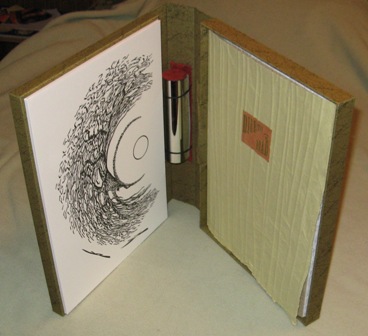 Direction of the Road is a favorite among JCBA fans & employees. Science fiction & fantasy writer Ursula Le Guin wrote the story & artist Aaron Johnson constructed the book, box & images. The book is made out of over-beaten homemade linen paper & bound together in a long stitch. The text is letterpress printed & paper leave are pasted on every page. The book is held in a portfolio box & on the inside of the box's cover is a woodcut image. On the inside of the spine of the box is a tube covered with reflective polymer.
 "Waiting for that other shoe to drop!" That is the theme for Art Spiegelman's first page of In the Shadow of No Towers & ultimately the theme of the whole book, which is Spiegelman's graphic essay about the anxiety & paranoia that came about after the 9/11 attacks on the Two Towers. When open, the book is too be read length-wise & is newspaper sized. The 10-page book starts from Spiegelman's thoughts on the attacks to the coming year filled with odd politics & fear-mongering. Spiegelman claimed he created the book to get over his post-traumatic stress disorder caused by being in New York City during that tragic time.