 |
| President Muffley |
 |
| Group Captain Lionel Mandrake |
 |
| Dr. Strangelove |
Dr. Strangelove has aged very well & is still relevant today & is considered one of the best political satires, if not the best.

|
| President Muffley |
|
| Group Captain Lionel Mandrake |
|
| Dr. Strangelove |


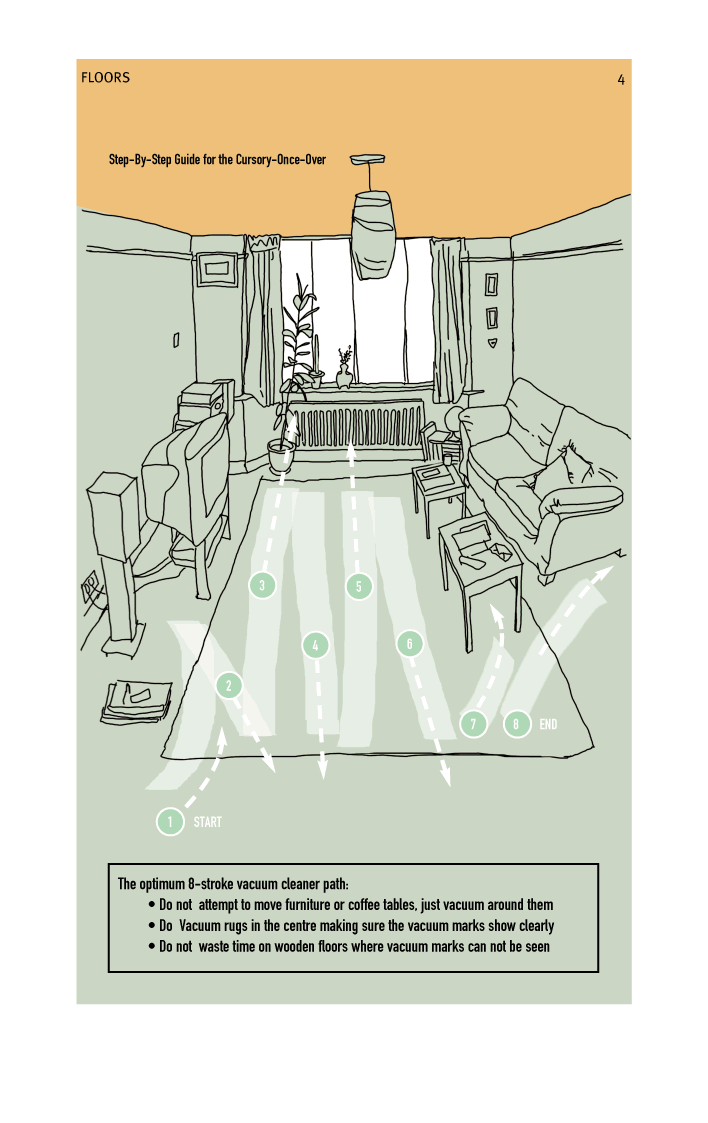 Do you cringe at the thought of having to clean your house for a mandatory party? Does a guest usually catch you off guard while your house is a disaster? Are you a modern woman who doesn't have the time to make your residence look pristine every damn minute? Well, we have the artists' book for you. Jackie Batey's Anxious Homes is the perfect guide for anyone who wants to appear to be tidy. Each book is inkjet printed & bound with a simple signature pamphlet stitch. Presented in a matter-of-fact, domineering tone, you will learn how to create vacuum lines on a rug or carpet, how to clean the taps in your bathroom, & methods to hide your hosting anxiety. This guide will "give the impression of a clean house in under 20 minutes," but if you have less than that, there are also steps for those with 10 minutes or 3 minutes. Now is your chance to be the falsely confident host your mother was.


 "It was a wrong number that started it all..." which is the line that starts City of Glass. In the graphic novel adaptation of Paul Auster's book of the same name, mystery writer Daniel Quinn gets a puzzling phone call asking for detective Paul Auster. After many nights for the same request, Quinn decides to play along & gets a case from Peter Stillman, a mentally abused man-child, & Stillman's wife & speech therapist, Victoria. They tell him that Stillman was locked in a dark closet for years by his father, Peter Stillman Sr., a professor who was seeking out the original language before the fall of man in the Garden of Eden. After serving time for child abuse, Peter Stillman Sr. is being released & the couple is worried that he may show up to get revenge, so they pay Auster (Quinn) to follow Stillman.
 That is the overall narrative structure of the novel, but this is more than just a detective story. There is much to say about this novel & I wrote out five paragraphs of analysis with more on my mind, but I deleted it all. It's just too heavy of a novel to be discussed in a couple of statements. There are assertions & contradictions in the novel about identity, authorship, & semiotics, along with many visual themes & motifs. If I were to teach a class on comic theory (which may or may not be a class anywhere, sadly) I would have this as part of my required reading. I also didn't realize this, but City of Glass perfectly pairs up with last months G.N.o.t.M., Understanding Comics. I would recommend reading that one first, and then hit City of Glass. It will help you with the match shots & panel transitions that are fill the pages, making City of Glass quite cerebral & technical.

 In this animated fantasy-adventure film, ten year-old Chihiro whines & complains to her parents about their move to a new home. On their way to their home, they come across an abandoned amusement park. While walking through the park, they see some deserted food, & to Chihiro disdain, her parents start to feast on it. Wandering the park, Chihiro spots a grand bathhouse; but, at nightfall, spirits start to appear in the park. She runs back to her parents, only to find them turned into pigs. A boy named Haku finds Chihiro & tells her that the place is a bathhouse for spirits & demons. In order for her to stay alive, she must get employment from the bathhouse's manager, the witch Yubaba. While working at the bathhouse, Chihiro comes across many ancient creatures, including Kamaji, the six-armed boiler room worker; No-Face, an empathetic wraith that feeds off the emotions of others; & a stink spirit, the worst customer to ever enter the bathhouse.
 Besides following a liminal progression, Spirited Away contains many themes often seen in Miyazaki's films, which includes pollution (symbolized in the stink spirit), greed & gluttony (symbolized in Chihiro's parents), & the losing of customs & cultures in a global society. The later is a major point in the film, as Chihiro is isolated from the outside world & comes face-to-face with Japanese mythological creatures. And there are many Japanese symbols & customs shown in the film that may make it hard to follow for non-Japanese, but that is kind of the point. Chihiro doesn't understand most of it either, showing a decline in traditions.
